Corpus Sicut Mens, Mens Sicut Corpus
Mens et Manus.
The motto of my alma mater.
Mind and Hand, "This motto reflects the educational ideals of MIT’s founders who were promoting, above all, education for practical application."
I find this funny, for who dictates what applications are practical? In today's day and age, 'practical applications' of the highest degree (and paychecks) are more often being associated with the technocratic world, littered with the trigger words "AI, optimization, software, programming" the list goes on.
Upon my last visit to the MIT campus, I sat outside on a picnic bench, physical paper journal and pen in hand, observing the end of academic year scuttle. Scatterings of people sitting on the grass and tables, frantically typing away while trying to soak in the growing heat of the spring sun, recovering after what I am sure was a brutally cold Boston winter.
I wrote a brief entry.
Tuesday May 26th, 2025 - MIT Courtyard
Is all meaningful work now either in front of, or punctuated by a screen?
Something about the faint cold-blue glow on the faces of people who were sitting right under a radiating sun felt unsettling.
A prioritization of pixel light over the the one that cues us to wake up every single day, and has been doing so since the birth of our species.
For 350,000 years the sun has observed us working our mind and hands at practical applications, from picking fruit, fashioning stone tools, sharpening arrow heads, to smelting iron, to fashioning large industrial machines, but it is only in the most recent modern age that it has seen a practical application as a contender to its own light.
We have always lived with the cyclic nature of this life force, the primary life force of all and anything we value on this Earth, but now the allure of the 'artificial' has become gravitational, sucking us into its big, blue-light pixelated pull.
When attending MIT, I found a disconcerting trend. Practical applications that have been at the forefront of human questions for millennia are being silenced by the blaring self-importance of "technology" of the modern age.
This dark pull of "intellect" to screens and virtual spheres is most definitely a recent phenomenon. To be a scholar in the peak of the Islamic Golden Age (622 AD - 1258 AD) was to be versed in variety of subjects, with philosophy and theology centered as driving forces for the pursuit of further knowledge.
Al-Khwārizmī (780 AD— 850 AD) was one such scholar who created a discipline integral to life as we know it now, algebra. But as much as Al-Khwārizimī investigated the nature of numbers, he was also a geographer, an astronomer, and a philosopher working at "The House of Wisdom" AKA The Royal Library of Baghdad.

To him, numbers were easily interchangeable with the larger philosophical questions of human value and morality, with him supposedly having generated a "moral algorithm" stating:
If a man has morals (اخلاق), he is worth 1.
If he also has knowledge (علم), add a zero: 10.
If he gains wealth (دولت) alongside morals and knowledge, add another zero: 100.
If he develops strong character (شخصیت), the value becomes 1000.
But if you take away morals, the 1 is removed—and nothing remains but zeros.
But one doesn't have to travel so far back in time to see philosophical inquiry amongst academics, as most scholars of the 1800's, of which we are far more familiar with in the modern age, were philosophers in their own right.
My personal favorite is Alexander Humboldt (1769 - 1859) (shout out to the Book The Invention of Nature) who conceptualized "The Web of Life" and built the foundation of modern western Ecology based on his experiences living with many indigenous groups of the Americas. A staunch anti-colonialist, who denounced exploitation in the name of preserving nature, and the rich cultures he fell in love with in his time in South America.
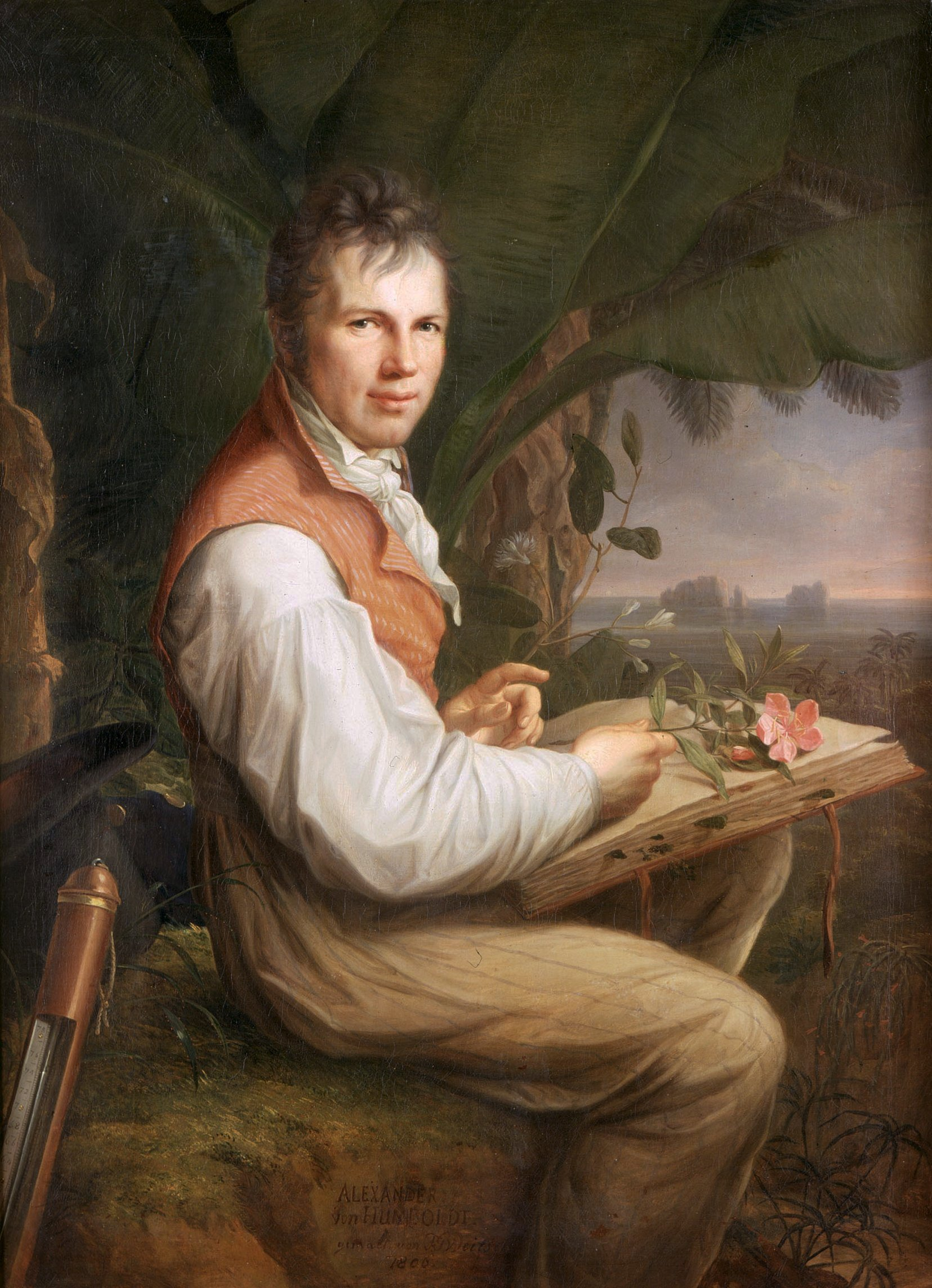
He was a German polymath, geographer, naturalist, explorer, and proponent of Romantic philosophy.
"Romanticism is a philosophical movement during the Age of Enlightenment which emphasizes emotional self-awareness as a necessary pre-condition to improving society and bettering the human condition."
"Among the characteristic attitudes of Romanticism were the following: a deepened appreciation of the beauties of nature; a general exaltation of emotion over reason and of the senses over intellect; a turning in upon the self and a heightened examination of human personality and its moods and mental potentialities; a focus on his or her passions and inner struggles; a new view of the artist as a supremely individual creator, whose creative spirit is more important than strict adherence to formal rules and traditional procedures; an emphasis upon imagination as a gateway to transcendent experience and spiritual truth; an interest in folk culture, national and ethnic cultural origins."
And of Humboldt's quotes, some of my favorite include:
“What speaks to the soul, escapes our measurements.”
“I saw with regret, (and all scientific men have shared this feeling) that whilst the number of accurate instruments was daily increasing, we were still ignorant.”
“The most dangerous worldviews are the worldviews of those who have never viewed the world.”
“Our imagination is struck only by what is great; but the lover of natural philosophy should reflect equally on little things."
I will return to these men and their thoughts in a bit.
For now, I propose a new motto, planted in my mind by a bus ride I took out to the Western Ghats in Southern India, for the education found beyond marbled walls, blue-pixelated light, and cramped office rooms.
Corpus Sicut Mens, Mens Sicut Corpus
body like mind, mind like body
A motto for an education that feeds body and soul as much as the mind.
I will elaborate more later as well.
Some time in June of 2023, I found myself scuttling into an over-stuffed bus filled to the brim with backpacks and camping gear at a busy Bangalore intersection, asking myself why I was braving nighttime urban India as a solo foreign woman.
But my fears were soon silenced after I found a seat in the front of the bus and a jittery, nerdy looking man stood over the seat next to me, pushing his glasses up his nose as a wide friendly smile gleamed on his face.
"Can I sit here?"
"Oh yes, of course."
And in the good friendly nature that I have come to know Indians for, we quickly delved into conversations about our backgrounds, our families, our life stories despite our eyelids both occasionally succumbing to our lack of sleep.
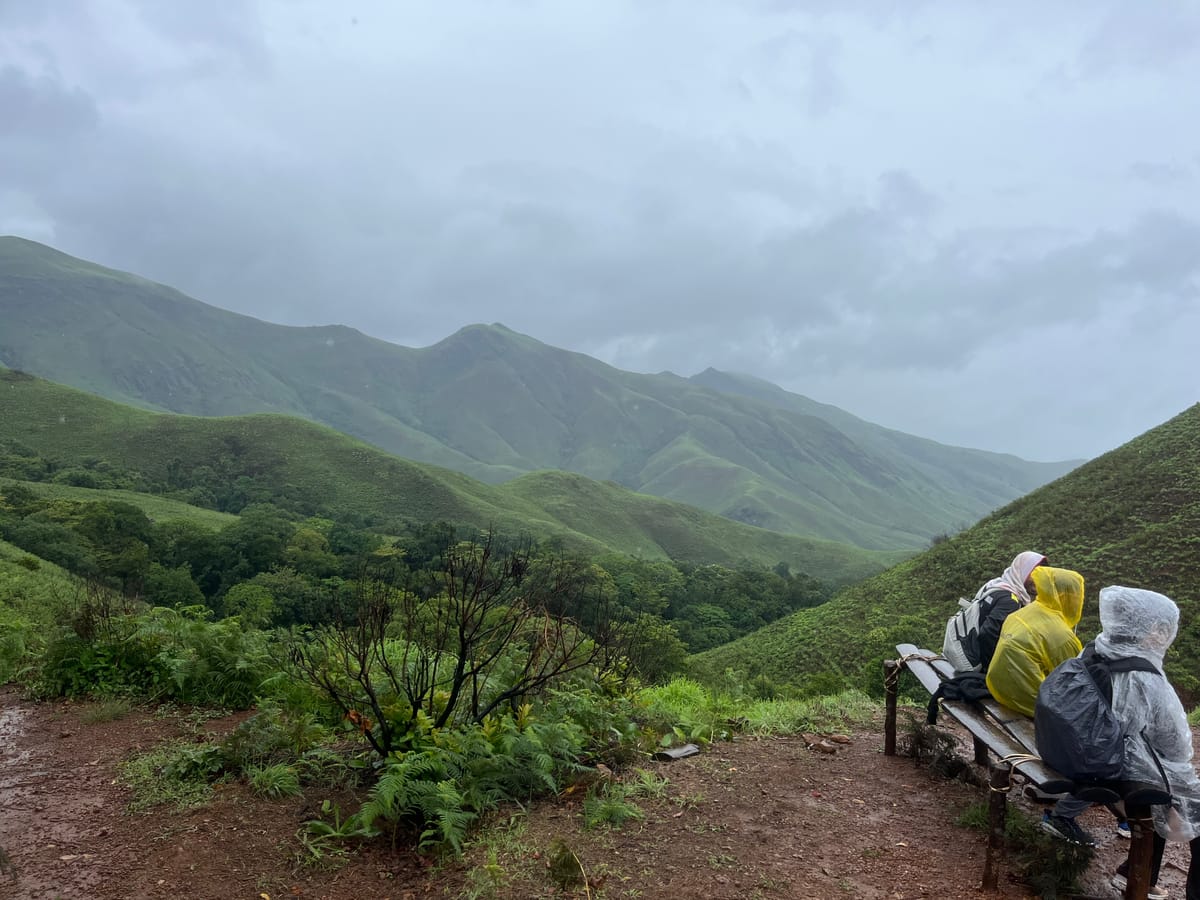
And it was here, in this conversation on this bus ride out to Kudremukh, a 14 mile hike through the lush rolling hills of the Western Ghats, that a newfound discomfort started to sprout within me.
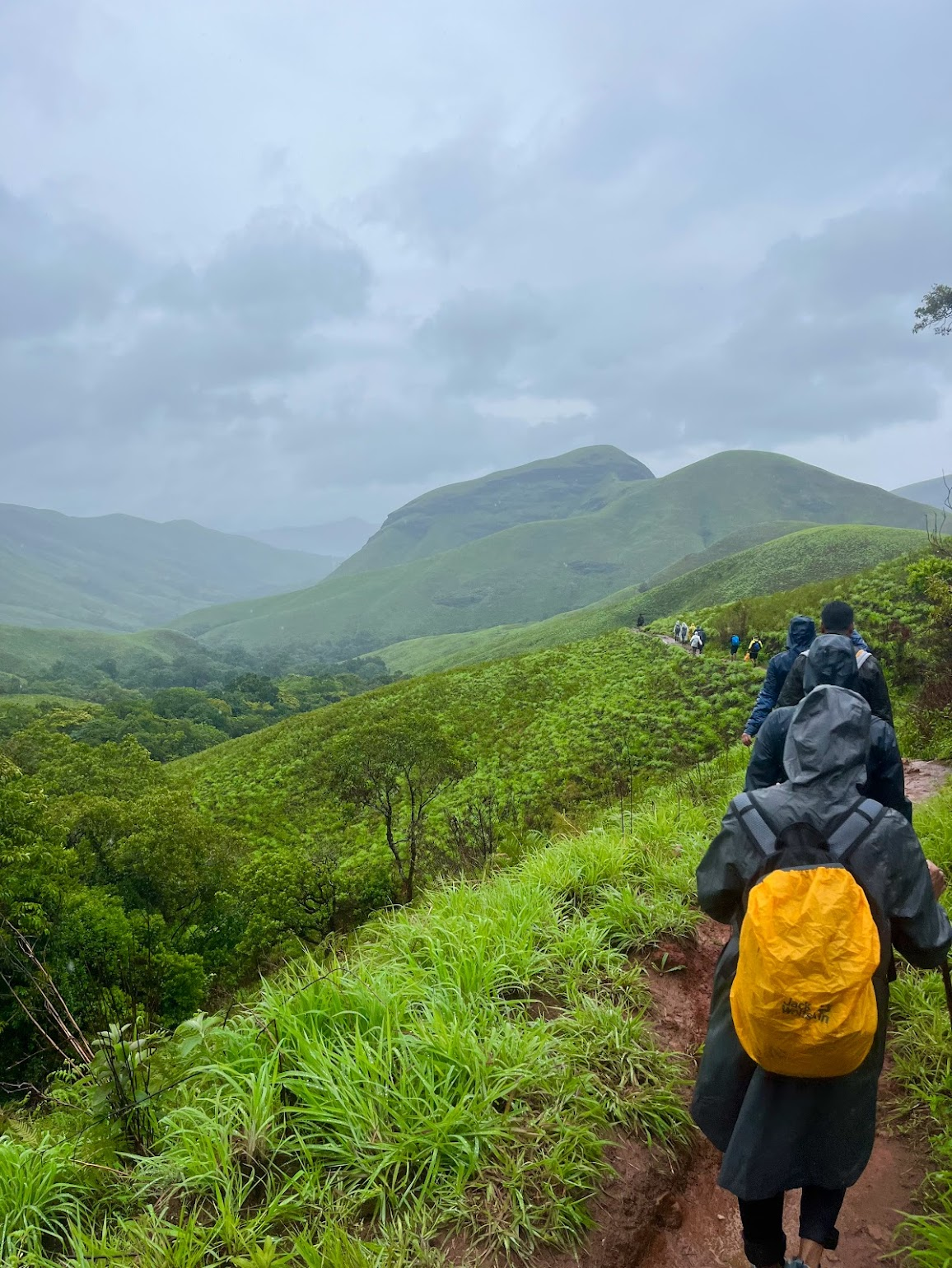
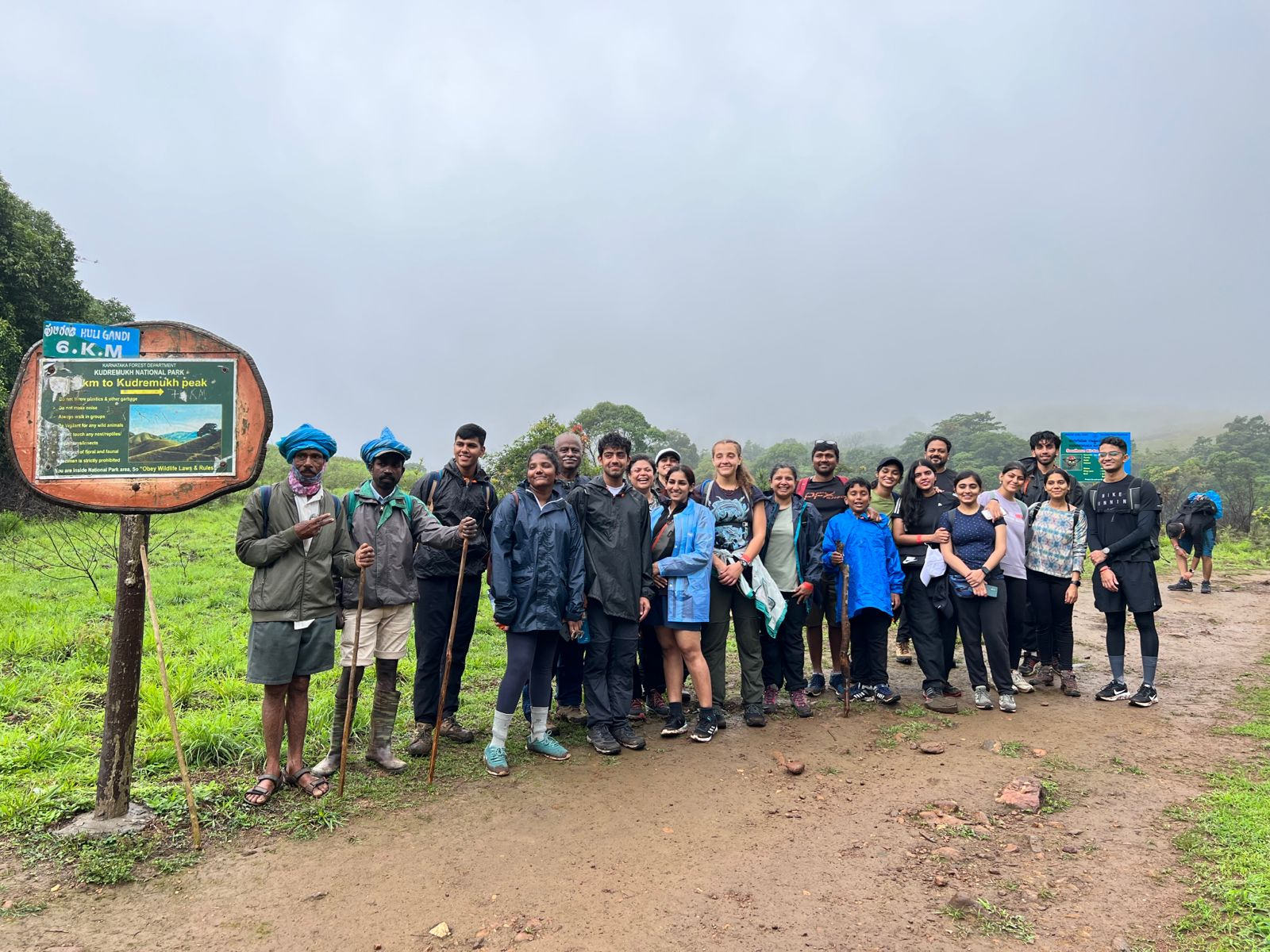
The dialogue went something like this:
My New Friend (MNF): "What religion are you?"
Me: "Oh, I grew up exposed to many religions, I wouldn't say I am an adherent of any one religion, my father is atheist essentially, my mother Catholic, exposed to Buddhism in Sri Lanka, half of my family is also Muslim."
MNF: "That is really good, to be open minded, I am Jain, and we believe in respect, respect for all. I am a strict vegetarian. But you know you all in the west, you have spent so much time on knowledge of the technical, of sciences and numbers, but you have a problem. You think you are better for this, but the religions and thoughts we have created in India have spent far more time investigating the mind, asking questions of purpose, of meaning, that the west has forgotten about in their obsession with "knowledge" as they know it. We maybe did not find the atom, but we have forever asked ourselves the questions of who are we? What is our purpose in this world? Yogis went to meditate on these things, to detach themselves from reality and material needs to find out, why are we here? And we have founded principles based on these discoveries, but the west does not value them as much as they value their research and 'empirical knowledge'."
And it was in that conversation I realized, in my (at the time) 3 years at MIT, I had never been asked truly, deeply, what am I doing here? What is my purpose in doing anything I have ever pursued in my life? In that moment I realized, I had just been following the motions of what I "should" be doing, in the pursuit of what success looked like to everyone around me, for I had never crafted a real sense of what my own success, for my soul, looked like.
What also startled me, is how easily this man slipped into discussions about meaning and purpose, because in the productivity-obsessed sphere of the west, you would never find it appropriate to delve into discussions of life-purpose within 20 minutes of meeting a stranger, for you would be asking many to be poking into a void they have ignored most of their life.
(Trust me I'll tie all these threads together soon enough)
Back to this:
Tuesday May 26th, 2025 - MIT Courtyard
Is all meaningful work now either in front of, or punctuated by a screen?
In the month that I made this entry, I had a discussion with one of my friends after she met up with old MIT Alums from her own early college days.
"Wow, you know MIT used to really have a wider spread of people in different majors than they do now? It was crazy meeting up with people who graduated in the early 10's, they were all like NOT course 6's (computer science)."
As a Course 7 (Biology) myself, I knew very well what being an MIT student in one of the "minority" majors felt like, often unable to partake in the typical hangout MIT nerd computer science talk, so to think maybe there was a point in the history of the Institute that my major wasn't so much a minority intrigued me.
So, of course there's always data, so lets take a look:
MIT Enrollment Statistics 2000-2001 academic year by Major:
(Main majors)
- Total Undergraduate Enrollment (Fall 2000): 4,162.
- Electrical Engineering and Computer Science (VI): 9.15%
- Biology (VII): 5.02%
- Mathematics (XVIII): 4.13%
- Mechanical Engineering (II): 3.65%
- Chemical Engineering (X): 3.36%
- Physics (VIII): 0.81%
- Management (XV): 2.72%
- Aerospace Engineering (XVI): 1.97%
- Economics (XIV): 1.42%
- Materials Science and Engineering (III): 1.24%
- (Low percentages reflect a wider spread across the other 10 majors MIT had to offer)
MIT Enrollment Statistics 2025-2026 by Major:
- Total Undergraduate Enrollment (Fall 2025): 4,561
- Electrical Engineering and Computer Science (VI) (including interdisciplinary versions of the course): 32.5%
- (Only Pure Computer science AKA Course 6-3): 14%
- Biology (VII): 0.79%
- Mathematics (XVIII): 5.72%
- Mechanical Engineering (II): 9.31%
- Chemical Engineering (X): 0.88%
- Physics (VIII): 3.79%
- Management (XV): 2.98%
- Aerospace Engineering (XVI): 3.17%
- Economics (XIV): 1.45%
- Materials Science and Engineering (III): 1.33%
Ok my stats might be a little off because MIT has a whole bunch of interdisciplinary stuff and I didn't know what I should count for where, but I think even with some human error, the trend is clear.
Computer science. Computer science. Computer science. Computer science.
I noticed coming in to MIT as a freshman, we all used to be so bright eyed and bushy tailed, with dreams of saving the world, ending cancer, or finally finding a way to sequester all the CO2 we're choking our planet with out of the atmosphere.
We declare our majors our 2nd year.
And by the time we graduated, I found myself being one of the very few not being dragged off to Google, Facebook, Amazon, some AI giant, machine learning, hunk of a corporation, or maybe if you're lucky someone was being dragged off to a more innocuous seeming AI/Machine learning start-up. But it was all the same, in some pursuit of six figures, stability, and following the same trends as every one else, I saw the same outcome over and over and over again. Basically no one I knew was out there trying to sequester CO2 any more.
(Ok so here goes my try to tie everything together, wish me luck)
So maybe you're thinking, but Katy it's an Institute of TECHNOLOGY, obviously the trends are going to follow whatever is the big new technology of the era, and as of now everything is AI, AI, AI.
Let me tell you that sun up there that's been watching our species this whole time is probably chuckling to itself.
Because it's seen us go through every single phase of our species' evolution, and knows we're pummeling ourselves into our final darkness, it'll still be up there burning bright, but we will no longer be around to see it any more, because what are we doing? What are we truly fucking doing?
No one wants to ask.
On another bus ride, this one through the mountains of Sri Lanka, I had an MIT friend of mine backpacking with me, and after revealing to her I had started taking on my meditation journey seriously after my aforementioned bus ride in India, she said to me:
"I wish I could meditate, but I have this wall, I just pack everything behind the wall, and if I broke it down I don't know what's behind it, I've spent too long just doing what I need to do next, getting it done."
We are not only an Institute of Technology, we are supposed to be representatives of the smartest, the best and brightest, but what use is that when there is no direction? When no one wants to ask themselves what are they really doing in the scheme of it all? When we can have our mental power be herded into any which-way and corner by the allure of big dollar signs and status symbols?
Corpus Sicut Mens, Mens Sicut Corpus
body like mind, mind like body
Yogis of India did indeed set up an innumerable set of principles to help guide us in spirit, in soul. They understood that the mind is no different from the body. We all have different muscles that do different things, and if you want those muscles to get bigger, stronger, more powerful, you need to adopt habits that integrate their use into your day to day life, to tell the body "hey, this muscle is useful! Expend your resources to make sure it gets stronger!"
But when we train our bodies incorrectly, and focus on strengthening without any thought about balance and functionality, we end up with pain and long-term discomfort. If your legs are extremely strong, but your back is not, the connection between the two will begin to hurt until you put in the effort to fix it.
Body like mind.
What use is Mens et Manus when we forget everything in between? What about our questions of morality? Of faith? Of purpose? Of compassion? We are so focused on numbers, on goals, on prowess that we forget ultimate purpose. I think my friend on my bus ride in Sri Lanka is not the only one of the supposed MIT geniuses that try to hide their feelings of directionlessness behind a torrent of fast-paced work and hard technical questions, but if you ask them the deeper, bigger why? It might be the hardest question they've ever had to face, because the connection between hand and the mind has been forgotten.
What about the habits of contemplation? Of silence? Of awe? Of recognizing the beauty of the world just how it is? In a cram packed schedule of classes and hyper-productivity, I found very few MIT students ever had even 5 minutes to focus on such concepts.
And I think all those AI/Technocratic money making schemes are taking advantage of it.
Mind like body.
But all action begins in the brain, and I brought up Al-Khwārizmī and Alexander Humboldt to show that there was an era where knowledge was to be pursued in the interest of a building a holistic individual. That one's mental speciality could be used as a form of exercise for all the muscles of the mind, morality and philosophy included. The autodidact in those times often holed themselves up in the pursuit of discovery for no one but themselves, working through every muscle of contemplation in the process.
And I ask myself, how many could say the same now in this world of AI media overload, six-figure chasing and directionless momentum?
I don't know.